

It is called a “manhole cover.” That is how the Balloon Club of America inflated a gas balloon. Incorporated as a sport ballooning club in 1952 with the first balloon flight from Brookhaven, Pennsylvania on November 29, 1952. Four men flew in the basket on this historic flight. Tony Fairbanks and Don Piccard as pilots. John Dura and Jerry Burns as passengers. Tony was the pilot for the two hour flight from Brookhaven Pennsylvania, a flight over the Delaware River, and a landing in Salem New Jersey. Don was the pilot for the second flight of the day from Salem, New Jersey for a landing in Hammonton, New Jersey. The balloon reached an altitude of 6,700 feet above the ground. To better train pilots and crew it became the practice of the Balloon Club to make multiple landings during a gas balloon flight.
The Balloon Club of America had two massive 80,000 cu.ft. rubberized cotton fabric gas balloons. Goodyear of Akron, Ohio manufactured the balloons to train blimp pilots during World War II. The balloon being flown on this day was built in June 1926. This balloon was named “the Old 80.” The second 80,000 cu.ft. gas balloon was built in May 1937. This was called “the New 80.”
The heavy envelope had to be rolled off the trailer onto a grass field. It would have been previously folded for inflation. On the field the envelope could be seen as a large circle with the wooden wishbone gas release valve on top and the inflation sleeve on the bottom. In the darkness of the early morning, the crew would pull the cotton net over the stationary envelope. The grass field was illuminated by the headlights of four or five automobiles.
On the side of the field was a large pile of fine sand delivered the day before. The crew had to fill seventy-five sand bags to be placed around the equator of the balloon to be connected to the cotton net by a hook. As the balloon was inflated the sandbags would be lowered on the net “down one diamond.” Fourteen sand bags of thirty pounds each would be placed inside the basket to act as ballast during the flight.
The inflation sleeve was attached to the bottom of the balloon and rolled out until the sleeve reached the city street along the edge of the field. Then there was the wait for the arrival of two men from the Philadelphia Electric Company. The Balloon Club of America had a contract which allowed natural gas or cooking gas to flow from under the ground into the balloon envelope for $185.00 for each inflation. The contract required a minimum of six inflations per calendar year. This is the same cooking gas which is attached to homes to power gas ovens and other appliances.
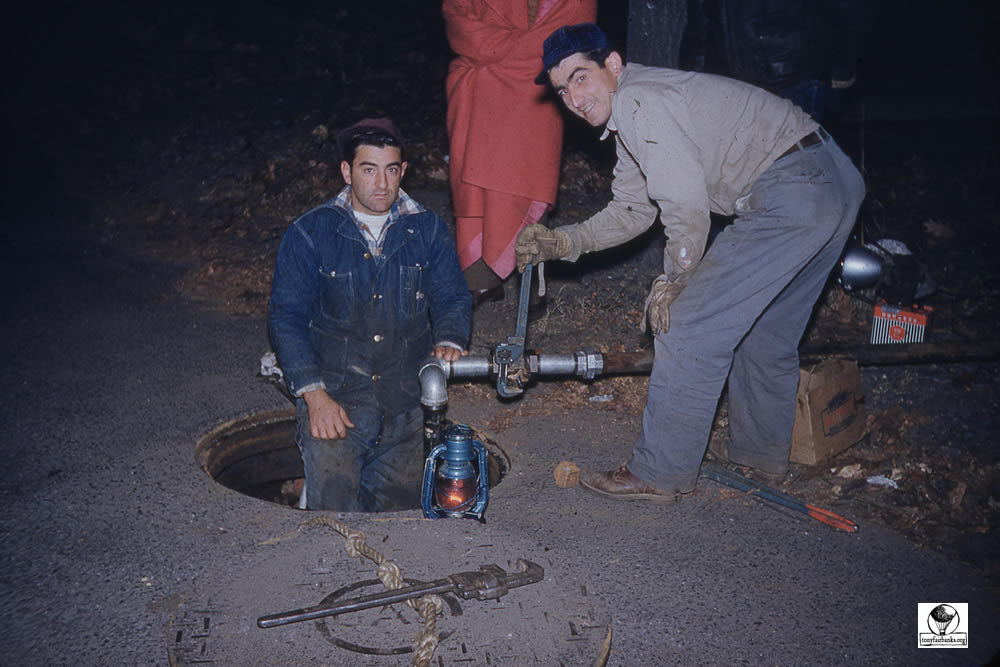
The men from the Philadelphia Electric Company would remove the manhole cover and step-down into the hole in the ground. A crew member would hand the inflation sleeve to the men to be connected to a pipe. The reason for two men should be obvious. One man to turn the gas valve and the second man to supervise.
I shall never forget the loud sound of the cooking gas flowing through the inflation sleeve into the balloon or the crew chief calling “down one diamond” as the balloon, painted a bright silver color, pushed upward against the net. From the arrival of the crew on the field to the launch of the balloon required four or at times five hours.
What a glorious sight. With the rising of the bright morning sun the lift-off into the sky of a gas balloon to float on the wind, to touch the clouds. The pilot and crew waving to the crowd as the balloon and small wicker basket drifted higher and higher above the ground below.
Written by Michael Fairbanks
The men are preparing to turn on the gas for the inflation.
Listen to gas inflation by Tony recording.